GEOTECHNICAL ENGINEERING
BELLEVILLE ONTARIO
HomeFoundationsPile foundation design

Pile Foundation Design in Belleville Ontario: Deep Foundation Solutions for Glacial Soils

Knowledgeable. Thorough. Resourceful.

LEARN MORE

Belleville sits at roughly 76 meters above sea level on the Bay of Quinte, but the subsurface tells a more complicated story. Boreholes across the city consistently reveal fractured limestone bedrock of the Gull River Formation at depths that shift dramatically — sometimes 4 meters, other times 18 — within a single city block. The overburden is predominantly glacial till interspersed with glaciolacustrine clay lenses deposited by Lake Iroquois roughly twelve thousand years ago, creating conditions that make shallow footings unreliable for any structure exceeding two storeys. Our team has pulled Shelby tube samples from the North Front Street corridor where undrained shear strength values dropped below 35 kPa at 6 meters depth, a scenario that demands pile foundation design that transfers load well past the soft zone into competent limestone. When granular till dominates and end-bearing capacity is the target, we often recommend supplementing the investigation with CPT soundings to delineate the exact refusal depth across the footprint before finalizing pile lengths.

Pile design in Belleville is fundamentally a bedrock predictability problem — knowing where the Gull River Formation drops, dips, or transitions to shale governs every capacity calculation and construction method.
Our service areas

Methodology and scope

The contrast between two Belleville project sites illustrates why pile design here resists standardization. Along Dundas Street West near the mouth of the Moira River, weathered shale interbeds within the limestone create a variable bearing stratum where driven H-piles can punch through unexpectedly — we documented a 20% capacity shortfall on one test pile before switching to a drilled and socketed alternative. Three kilometers east in the industrial park off College Street, a dense silty till with N-values exceeding 45 blows per foot provides excellent skin friction, allowing a tapered pile section that reduced concrete volume by nearly one-third compared to the river-adjacent design. These micro-zonal differences drive our approach: we log stratigraphy against the Ontario Geological Survey bedrock topography maps, then calibrate pile type, diameter, and embedment depth using site-specific load test data. The slope stability analysis becomes a parallel concern wherever excavation for pile caps intersects the natural grade near the Bay of Quinte shoreline or along the Moira River escarpment, where a 2H:1V bench cut can trigger sloughing in saturated silt lenses if not dewatered and sequenced correctly.
Pile Foundation Design in Belleville Ontario: Deep Foundation Solutions for Glacial Soils
Technical reference — Belleville Ontario

Site-specific factors

NBCC 2020 Part 4 and CSA S500:2021 set the structural framework, but the geotechnical risk in Belleville concentrates at the pile-to-bedrock interface. The Gull River Formation exhibits karstic dissolution features in several documented zones east of the city core, where solution cavities up to 0.5 meters in diameter were encountered during bridge pier construction near Highway 401. A pile seated above such a void without detection — whether through probe drilling or cross-hole sonic logging during shaft construction — can experience sudden loss of end bearing under service load, a failure mode that develops without visible settlement warning. The glaciolacustrine clay layers add a secondary risk: negative skin friction when fill placement or site grading compresses these normally consolidated deposits, transferring downdrag forces into the pile that the structural section must resist. Our design reports explicitly calculate the neutral plane depth and specify bitumen coating or sleeving where the downdrag load would exceed 15% of the pile structural capacity, a threshold we rarely see crossed in the till-dominant west end but routinely trigger in the river corridor projects.

Need a geotechnical assessment?

Reply within 24h.

Email: contact@geotechnical-engineering.org

Relevant standards

NBCC 2020 Part 4 — Structural Design, CSA S500:2021 — Thermosyphon Foundations in Permafrost Zones (referenced for frost protection principles), ASTM D1143/D1143M-20 — Standard Test Methods for Deep Foundations Under Static Axial Compressive Load, ASTM D3966/D3966M-22 — Standard Test Methods for Deep Foundations Under Lateral Load, OPSS.MUNI 206 — Ontario Provincial Standard for Piling (municipal projects)

Technical data

ParameterTypical value
Design code for deep foundationsNBCC 2020 Part 4, CSA S500:2021
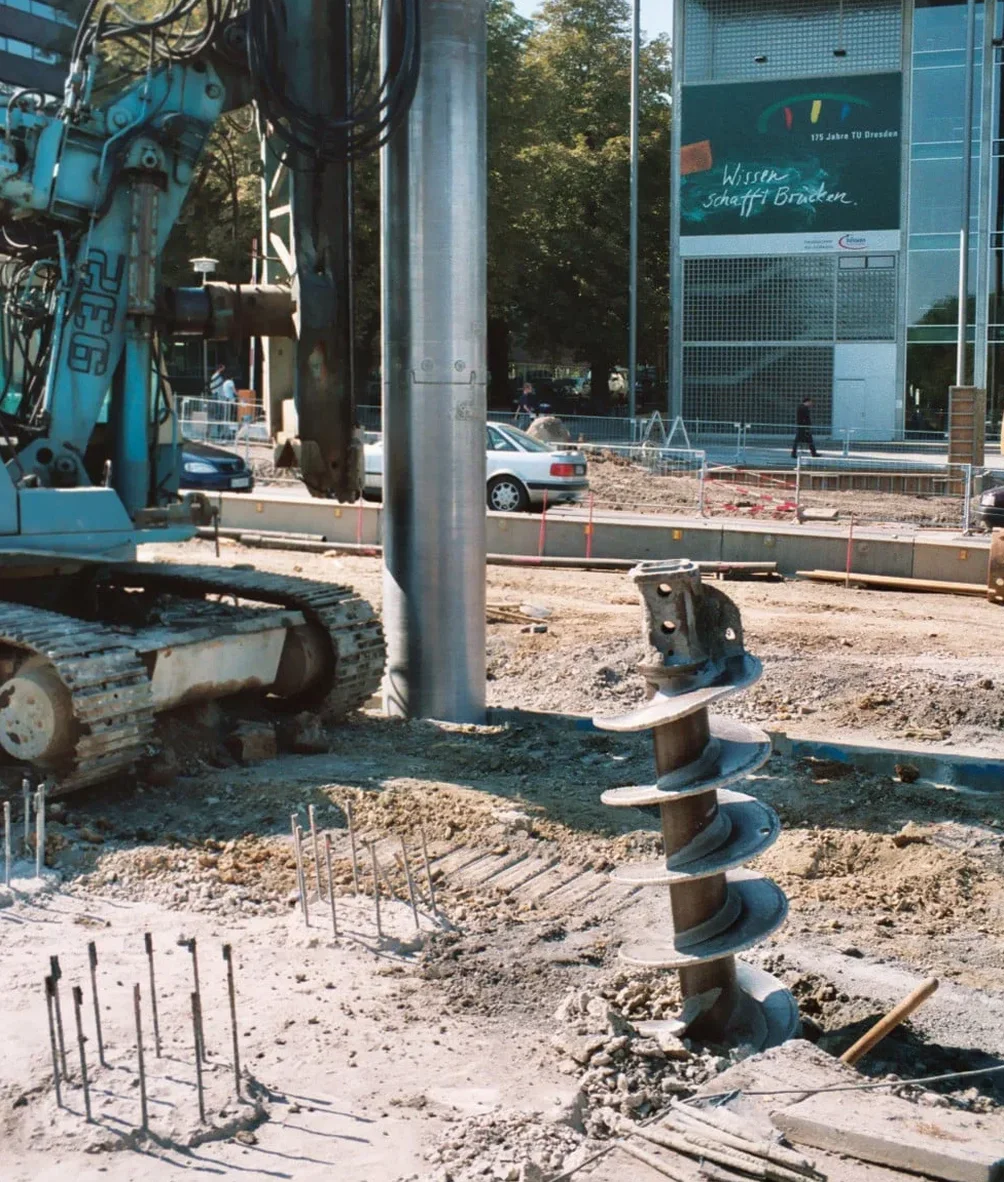
Typical pile types deployed in BellevilleDriven H-piles, drilled shafts, helical piles in low-access sites
Bedrock (Gull River Fm.) UCS range45–110 MPa depending on fracturing and shale content
Frost penetration depth (design)1.2 m per OBC/NBCC climate data for Belleville
Glacial till friction angle range32°–38° with cohesion intercept 0–15 kPa
Lacustrine clay undrained shear strength25–60 kPa (low to medium plasticity)
Typical pile load test methodASTM D1143 static load test with telltale extensometers

Common questions

What is the typical cost range for a pile foundation design package in Belleville?
How do you determine the pile termination depth in Belleville's variable limestone bedrock?

We use a combination of open-hole rotary drilling with continuous core recovery in the anticipated bearing zone, measuring rock quality designation (RQD) and fracture frequency per meter. A minimum socket length of 1.5 to 3 pile diameters into RQD greater than 50% is specified, with probe drilling extending 3 meters below the socket tip in areas where karst features are suspected. The final refusal criterion is confirmed during construction through penetration rate monitoring and torque readings on the drill rig, correlated back to the design assumptions.

What pile types are best suited for the soft clay pockets found near the Moira River?

Drilled shafts with permanent casing through the clay zone provide the most reliable solution, as they eliminate the risk of necking during concrete placement and prevent negative skin friction transfer. Helical piles with a minimum shaft diameter of 178 mm and grouted extensions have also performed well on smaller structures where the clay thickness is under 3 meters, provided the helix plates reach the underlying dense till with sufficient embedment to mobilize bearing.

Do you perform lateral load analysis for pile foundations in Belleville?

Yes, lateral capacity is evaluated for every pile design using LPILE or equivalent p-y curve software, with soil modulus input derived from our site-specific SPT blow count correlations and, where warranted, pressuremeter testing in the upper 5 to 10 diameters. The controlling lateral load case is typically the NBCC seismic demand combined with wind, and we design the pile head connection and cap reinforcement to transfer the resulting moment into the foundation system without exceeding the allowable lateral deflection of 12 mm at the pile cap level.

Location and service area

We serve projects across Belleville Ontario and surrounding areas.

View larger map