GEOTECHNICAL ENGINEERING
BELLEVILLE ONTARIO
HomeLaboratoryLaboratory CBR test

Laboratory CBR Testing in Belleville Ontario: Pavement Design on Glacial Soils

Knowledgeable. Thorough. Resourceful.

LEARN MORE

Belleville's road infrastructure has expanded steadily since the Loyalist settlement era, but the real engineering challenge lies beneath the asphalt. The city rests on a complex mix of glacial till, silty clay, and occasional limestone bedrock near the Moira River, with a population of over 50,000 driving daily on pavements that must withstand harsh freeze-thaw cycles. When the City upgraded Bell Boulevard a few years back, the pavement design relied heavily on [laboratory CBR testing](#) to assess the bearing capacity of the native silty subgrade. Without a reliable California Bearing Ratio value, even a well-compacted granular base can fail prematurely under Ontario's seasonal extremes. Our team has run hundreds of CBR tests on samples pulled from Belleville's east-end industrial parks and the residential subdivisions near Loyalist College, and the results consistently show that the local glacial till — when properly compacted — delivers CBR values in the 8 to 15 percent range. Complementing the CBR with a Proctor compaction curve is standard practice, since the moisture-density relationship directly governs the soaked strength reading you get in the lab.

A soaked CBR value below 3 percent on Belleville's silty clays can double the required granular base thickness compared to a subgrade with CBR above 10 percent.
Our service areas

Methodology and scope

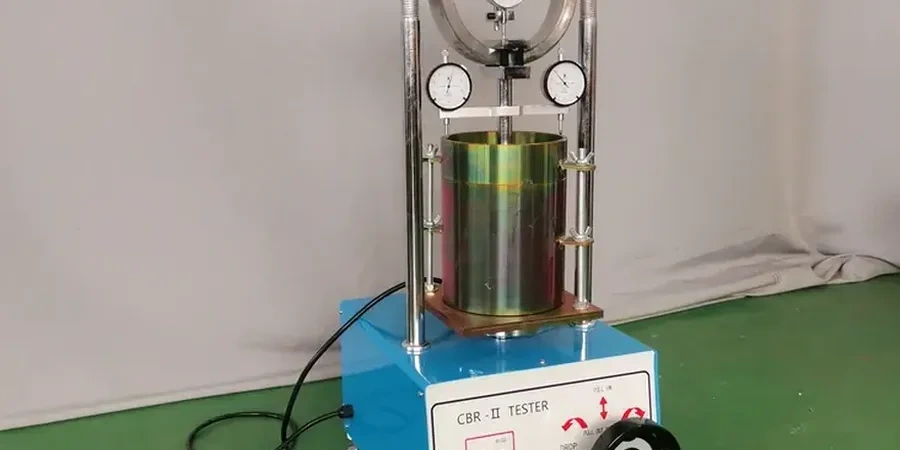
A recent project on Dundas Street West involved reconstructing a 400-meter segment where the existing pavement had developed severe alligator cracking. The investigation revealed a silty clay subgrade with a soaked CBR below 3 percent, which explained the premature failure. We performed a laboratory CBR test following ASTM D1883-21 on remolded specimens compacted at 95 percent of the modified Proctor maximum dry density. The test ran for 96 hours of soaking with a 4.5 kg surcharge to simulate the overlying pavement structure, and the penetration readings at 0.1-inch intervals gave us a design CBR of 4.2 percent. Those numbers fed directly into the AASHTO 1993 pavement design equation, determining the required granular base thickness. When we encounter such weak subgrades in Belleville's northern clay belt, we often recommend coupling the CBR assessment with grain size analysis to quantify the fines content, which typically exceeds 60 percent in these Champlain Sea-derived deposits. The laboratory CBR test remains the most practical index for correlating subgrade strength to pavement section requirements, especially when in-situ conditions are too variable for a reliable field CBR.
Laboratory CBR Testing in Belleville Ontario: Pavement Design on Glacial Soils
Technical reference — Belleville Ontario

Site-specific factors

Ontario's Ministry of Transportation (MTO) pavement design manual references the CBR method as a key input for flexible pavement thickness determination, and ignoring laboratory CBR testing on Belleville's moisture-sensitive silts can lead to severe underdesign. The city's average annual precipitation of 960 mm, combined with spring thaw saturation, produces soaked subgrade conditions that are far weaker than the dry samples some contractors prefer to test. We have reviewed forensic reports from failed parking lots in the Bell Boulevard commercial zone where the design assumed a CBR of 10 percent, but the actual soaked value measured later was under 4 percent — the asphalt cracked within two winters. The laboratory CBR test accounts for this worst-case scenario by soaking the specimen before penetration, which is critical in a climate where the frost line reaches 1.2 meters. In our experience, Belleville projects that skip the soaked CBR or rely solely on in-situ DCP correlations end up with granular bases that are 150 to 200 mm too thin for the actual subgrade strength.

Need a geotechnical assessment?

Reply within 24h.

Email: contact@geotechnical-engineering.org

Watch the video

Relevant standards

ASTM D1883-21: Standard Test Method for California Bearing Ratio of Laboratory-Compacted Soils, ASTM D1557-12e1: Standard Test Methods for Laboratory Compaction Characteristics of Soil Using Modified Effort, AASHTO T 193-13: The California Bearing Ratio, MTO Laboratory Testing Manual (LS-700 series), NBCC 2015: National Building Code of Canada (geotechnical references)

Technical data

ParameterTypical value
Applicable standardASTM D1883-21
Specimen compaction methodModified Proctor (ASTM D1557) or Standard Proctor (ASTM D698)
Soaking period96 hours under 4.5 kg surcharge weight
Penetration rate1.27 mm/min (0.05 in/min)
Penetration readingsAt 0.64, 1.27, 1.91, 2.54, 3.18, 3.81, 4.45, 5.08, 7.62, 10.16, 12.70 mm
Surcharge mass4.54 kg (minimum, annular and slotted weights)
Mold diameter152.4 mm (6 in) for material passing 19 mm sieve
Typical Belleville CBR range (glacial till)8 to 15 percent (soaked, 95% compaction)

Common questions

How much does a laboratory CBR test cost in Belleville?
Why is the soaked CBR test required for Belleville pavements instead of a field CBR?

Field CBR tests on in-situ subgrade reflect the moisture condition at the time of testing, which in Belleville can vary dramatically between a dry August and a saturated April. The laboratory soaked CBR simulates the worst-case scenario — a subgrade fully saturated after spring thaw or prolonged rainfall — which is the condition that governs pavement design life in Ontario's climate. The MTO pavement design method explicitly requires soaked laboratory CBR values as the design input.

What sample size do you need for a laboratory CBR test?

We typically require about 25 to 30 kg of disturbed bulk sample passing the 19 mm sieve for a single CBR point with compaction curve. The material should be representative of the subgrade stratum at the design elevation. If gravel particles larger than 19 mm are present, we can discuss scalping procedures or alternative mold sizes per ASTM D1883.

Location and service area

We serve projects across Belleville Ontario and surrounding areas.

View larger map