GEOTECHNICAL ENGINEERING
BELLEVILLE ONTARIO
HomeGround improvementVibrocompaction design

Vibrocompaction Design in Belleville Ontario: Compaction for Loose Granular Soils

Knowledgeable. Thorough. Resourceful.

LEARN MORE

The National Building Code of Canada (NBCC 2015) sets strict limits on total and differential settlement, and in Belleville’s glaciolacustrine deposits, loose sands and silty sands often fail these criteria at depth. We design vibrocompaction programs that increase relative density to 70–85% below footings and slabs, verified through pre- and post-treatment CPT testing. The city’s location on the north shore of Lake Ontario means groundwater is typically within 2–3 m of grade, which actually aids the vibratory process but requires careful control of withdrawal rates so fines don’t clog the stone column if combined with stone columns in transitional zones. Our approach ties compaction grid spacing, probe energy, and treatment depth directly to the geotechnical baseline report.

In Belleville’s loose deltaic sands, well-designed vibrocompaction can eliminate deep foundations and cut settlement from 50 mm to under 15 mm.
Our service areas

Methodology and scope

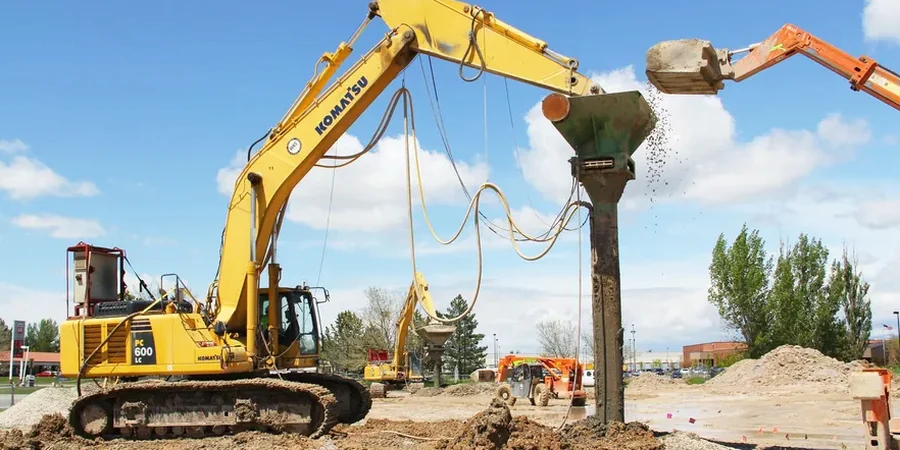
The rigs we mobilise in Belleville use electric or hydraulic vibrators suspended from crawler cranes, typically with 130–180 kW power packs delivering 1,500–2,000 rpm. Probe diameters range from 300 to 450 mm, and water jets at the tip fluidise the granular matrix so the vibrator can sink under its own weight. Compaction is achieved in lifts as the probe is extracted in 0.5–1.0 m stages, with hold time adjusted until the ammeter stabilises—our field engineers watch that gauge obsessively because it’s the only real-time indicator of density gain. In the city’s silty fine sands near the Moira River floodplain, we often specify a pre-treatment grain-size analysis to confirm fines content stays below the 15–18% threshold where vibratory methods lose efficiency. When site access is tight in the older residential pockets south of Dundas Street, we switch to smaller bottom-feed units that don’t need a separate stone hopper.
Vibrocompaction Design in Belleville Ontario: Compaction for Loose Granular Soils
Technical reference — Belleville Ontario

Site-specific factors

The contrast between the limestone till plains north of Highway 401 and the river-mouth sands near Zwicks Park couldn’t be starker. North of the 401, dense basal till sits shallow, and vibrocompaction is rarely needed—maybe a few metres of surficial fill. Down by the Bay of Quinte shoreline, however, 8–15 m of loose saturated sand overlies bedrock, and standard footings here would risk differential settlement exceeding 40 mm. Without treatment, liquefaction susceptibility is real: the NBCC assigns Belleville a peak ground acceleration of 0.15–0.20 g on Site Class D, and loose sands with SPT N-values below 10 can trigger cyclic mobility in a 2%–in–50–year seismic event. The design challenge is transitioning treatment depth smoothly across these geological boundaries so post-construction settlement remains uniform under the entire footprint.

Need a geotechnical assessment?

Reply within 24h.

Email: contact@geotechnical-engineering.org

Relevant standards

NBCC 2015 (Division B, Part 4), CSA A23.3-14, ASTM D1586-18 (SPT correlation), ASTM D5778-20 (CPT verification), FHWA-NHI-16-027 Ground Improvement Manual

Technical data

ParameterTypical value
Applicable standard for designFHWA-NHI-16-027, EN 14731:2005
Target relative density70–85% Dr (post-treatment)
Maximum treatment depth25 m (typical Belleville reach)
Probe spacing (square grid)1.5–3.0 m depending on silt content
Power pack rating130–180 kW
Min. CPT tip resistance (post-treatment)≥ 10–15 MPa in clean sands
Vibration frequency range1,500–2,000 rpm

Common questions

What soil types in Belleville respond best to vibrocompaction?

Clean sands and gravelly sands with less than 15% silt and less than 2% clay give the best result. In Belleville, the deltaic deposits near the Moira River mouth and the beach sands along the Bay of Quinte are ideal. If fines content exceeds 18% we usually recommend a stone column solution instead, because the silt dampens vibration transmission and blocks drainage.

How much does a vibrocompaction design package cost in Belleville?
How long does it take to go from design to verified compaction?

Design and specification work takes 5–8 business days after we receive the geotechnical baseline report. The field trial usually runs 1–2 days, and we need 3–5 days after the trial to run verification CPTs and issue the production plan. Full production for a 2,000 m² site typically takes 5–7 working days.

Can you compact right next to an existing house foundation on a Belleville infill lot?

Yes, but we reduce vibration amplitude and switch to a smaller probe in the 3–5 m exclusion zone closest to the existing footing. We also install a vibration monitoring point on the adjacent structure during the trial to confirm peak particle velocity stays below 5 mm/s. In our experience with the older brick homes in the East Hill neighbourhood, this approach has worked without incident.

Location and service area

We serve projects across Belleville Ontario and surrounding areas.

View larger map