GEOTECHNICAL ENGINEERING
BELLEVILLE ONTARIO
HomeSeismicBase isolation seismic design

Base Isolation Seismic Design in Belleville Ontario

Knowledgeable. Thorough. Resourceful.

LEARN MORE

The bedrock under Belleville changes almost block by block. Near the Bay of Quinte shoreline, you hit competent limestone at three metres. Head north toward the Highway 401 corridor and overburden thickens fast, with stiff clay and till deposits running past twelve metres before refusal. That contrast dictates isolation frequency. A building anchored into shallow rock responds with short-period motion and high acceleration transfer. The same structure floating on deep clay amplifies long-period displacement. Our team models both scenarios before selecting elastomeric or sliding bearing parameters. The goal is a consistent isolated period across the site, regardless of what sits underneath. In Belleville, that means running site-specific response spectra rather than defaulting to generic OBC soil factors. For deeper soil profiles where bedrock depth exceeds twenty metres, we often correlate isolation design with MASW surveys to establish Vs30 and confirm NEHRP site class boundaries before finalizing bearing stiffness.

An isolation system is only as good as its displacement capacity. In Belleville's site class C and D profiles, we design for 300 to 500 millimetres of lateral travel.

Our service areas

Methodology and scope

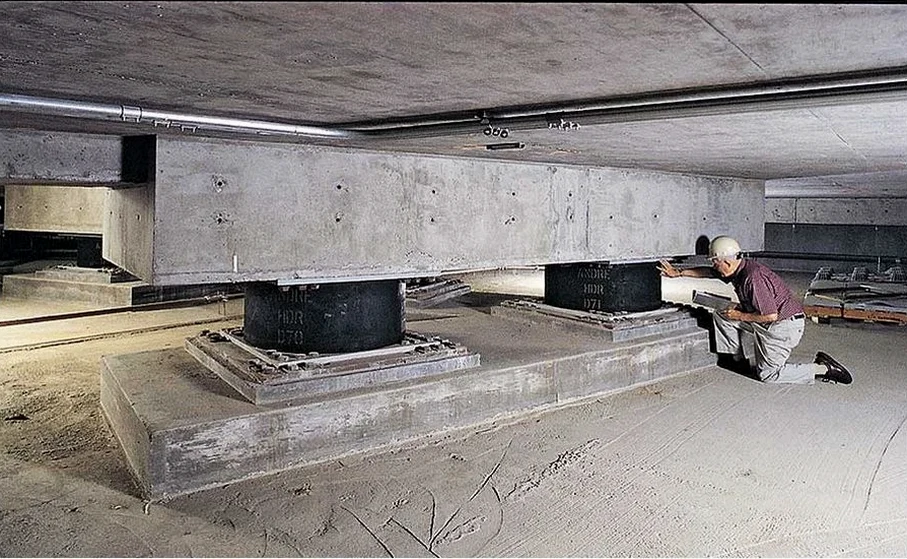
Eastern Ontario winter freeze-thaw cycles impose a performance requirement that warmer seismic zones ignore entirely. Belleville sees over forty freeze-thaw days annually, and the moisture trapped in isolation bearing components must not degrade under repeated thermal cycling. We specify low-temperature elastomer compounds rated to minus forty Celsius. The Moira River floodplain adds another layer: saturated silts in the river corridor lose stiffness during spring melt, altering the dynamic impedance at the foundation interface. Our isolation designs for Belleville buildings incorporate multi-level performance objectives. Life safety under the 2475-year return period earthquake. Immediate occupancy under the 475-year event. And continuous operation for post-disaster structures, which is non-negotiable for emergency services buildings downtown. Each bearing type, whether lead-rubber, high-damping rubber, or friction pendulum, undergoes prototype testing to twice the maximum considered earthquake displacement. The hysteresis loops tell the real story: energy dissipation per cycle, post-elastic stiffness ratio, and re-centering capability after repeated pulses.
Base Isolation Seismic Design in Belleville Ontario
Technical reference — Belleville Ontario

Site-specific factors

Belleville's industrial history concentrated along the waterfront from the 1870s onward, with brickworks, rail yards, and later manufacturing plants built on fill and alluvial deposits. That legacy complicates isolation retrofits. Old fill material, often undocumented, introduces variable compressibility under the new basement slab that supports the isolation plane. Differential settlement of just five millimetres across an isolator footprint can bind the bearing mechanism. We encountered this during a school retrofit near the downtown core, where 19th-century sawdust fill had decomposed into a spongy organic layer eight metres below grade. The isolation system demanded a rigid diaphragm across the entire footprint, coupled with compaction grouting beneath. New construction avoids these surprises with thorough investigation. Retrofits demand forensic-level understanding of what previous builders left behind. The NBCC 2020 Article 4.1.8.17 requires that isolation systems accommodate torsion from mass eccentricity. In Belleville buildings with irregular footprints, that eccentricity must be calculated, not assumed.

Need a geotechnical assessment?

Reply within 24h.

Email: contact@geotechnical-engineering.org

Relevant standards

NBCC 2020 Part 4, Article 4.1.8.17 (Base Isolation), CSA S6:19 Section 5 (Seismic Isolation for Bridges), ASCE/SEI 7-22 Chapter 17 (Seismic Isolation Provisions), ASTM D4014 (Elastomeric Bridge Bearings), EN 15129:2018 (Anti-seismic Devices)

Technical data

ParameterTypical value
Design earthquake return period2475 years (MCE)
Minimum isolation period target2.5 - 3.0 seconds
Effective damping ratio15% - 30% (based on bearing type)
Maximum considered earthquake displacement300 - 500 mm (site-specific)
Elastomer low-temperature rating-40 °C
Applicable NBCC site classesC (shallow rock), D (stiff soil)
Superstructure drift reduction60% - 80% versus fixed-base

Common questions

What is the typical cost range for base isolation design on a mid-rise building in Belleville?
Does base isolation eliminate the need for structural ductility?

No, it reduces ductility demand significantly but does not eliminate it. The superstructure must still maintain a minimum ductility capacity per NBCC 2020. The isolation system targets a force reduction factor between 2 and 3, meaning the structure above sees roughly one-third to one-half of the fixed-base seismic force. The remaining force still requires detailing for limited inelastic behaviour.

How does Belleville's limestone bedrock affect isolation performance?

The shallow limestone across much of Belleville produces high-frequency ground motion with peak accelerations that can exceed 0.4g at short periods. An isolation system lengthens the building period past 2.5 seconds, well beyond the spectral acceleration peak. The stiff rock also limits basin edge effects, which simplifies the ground motion characterization compared to deep soil basins.

What maintenance do isolation bearings require over the building lifespan?

Elastomeric bearings are designed for the building's service life with zero routine maintenance on the bearing elements themselves. However, the moat wall perimeter requires annual inspection to ensure no debris or hardscaping has bridged the seismic gap. After a significant earthquake exceeding 30 millimetres of residual displacement, an engineering inspection must verify bearing re-centering and check for elastomer cracking or steel shim yielding.

Location and service area

We serve projects across Belleville Ontario and surrounding areas.

View larger map