GEOTECHNICAL ENGINEERING
BELLEVILLE ONTARIO
HomeGround improvementStone column design

Stone Column Design in Belleville Ontario: Ground Improvement for Weak Soils

Knowledgeable. Thorough. Resourceful.

LEARN MORE

A warehouse expansion near the Moira River industrial corridor hit refusal at 1.8 meters. The bore log showed 9 meters of soft gray clay. Shallow footings would have settled over 150 millimeters. Three nearby projects had already switched to deep foundations. The budget could not absorb that switch. This is where stone column design shifts from a textbook concept to a real cost-saver. We analyzed the undrained shear strength profile. We sized the columns for a 25-millimeter residual settlement. The owner saved roughly 30 percent compared to driven piles. In Belleville Ontario, pockets of compressible Leda clay and loose silty deposits make ground improvement a practical alternative. Our approach combines in-situ permeability testing with vibro-replacement analysis to confirm drainage and load transfer mechanisms before construction begins.

A well-designed stone column grid transforms compressible clay into a composite mass that can support three-story structures without deep foundations.
Our service areas

Methodology and scope

Soil conditions change quickly across Belleville Ontario. The north end near Highway 401 sits on dense till. The older industrial zones along Pinnacle Street and the waterfront rest on thick sequences of soft lacustrine clay. That contrast demands different column geometries. A project on till might need only 600-millimeter diameters at 2.5-meter spacing. The same building footprint near the bay requires 900-millimeter columns on a tighter triangular grid. We model the composite ground stiffness using the Priebe method. We verify settlement reduction ratios against CPT tip resistance data. The design also accounts for radial drainage during column installation. In low-permeability clay, the pore pressure dissipation timeline dictates the safe loading schedule. For sites with marginal bearing layers, we often pair stone columns with a load transfer platform to distribute stress evenly and bridge any soft spots between column heads.
Stone Column Design in Belleville Ontario: Ground Improvement for Weak Soils
Technical reference — Belleville Ontario

Site-specific factors

We have inspected projects in Belleville Ontario where columns were terminated too early. The designer assumed refusal on a dense sand lens at 5 meters. The real compressible layer extended to 9 meters. Differential settlement cracked the slab within two years. Stone columns must penetrate the full soft zone and key into competent bearing soil. Partial depth designs fail. Another failure mode we see is underestimating the smear effect during installation. In sensitive clay, vibroflot vibration can temporarily reduce the surrounding soil strength. The design must specify a waiting period before load testing. We also check for liquefiable layers below the treatment depth. If a loose sand stratum exists at 10 meters, the columns do not solve that risk. A combined solution with liquefaction mitigation and deeper drainage may be needed. Belleville sits in a moderate seismic zone under NBCC 2020. We run post-earthquake settlement checks when the site class drops below C.

Need a geotechnical assessment?

Reply within 24h.

Email: contact@geotechnical-engineering.org

Relevant standards

NBCC 2020 – Seismic site classification and foundation design, CSA A23.3 – Concrete design for reinforced column caps, ASTM D1586 – Standard penetration test for soil profiling, ASTM D5778 – CPT for design verification, FHWA-NHI-16-072 – Ground Improvement Methods

Technical data

ParameterTypical value
Design methodologyPriebe method, FE axisymmetric models
Typical column diameter0.6 m – 1.0 m
Area replacement ratio10% – 35%
Target settlement reduction50% – 80% of untreated settlement
Undrained shear strength range15 kPa – 50 kPa (suitable)
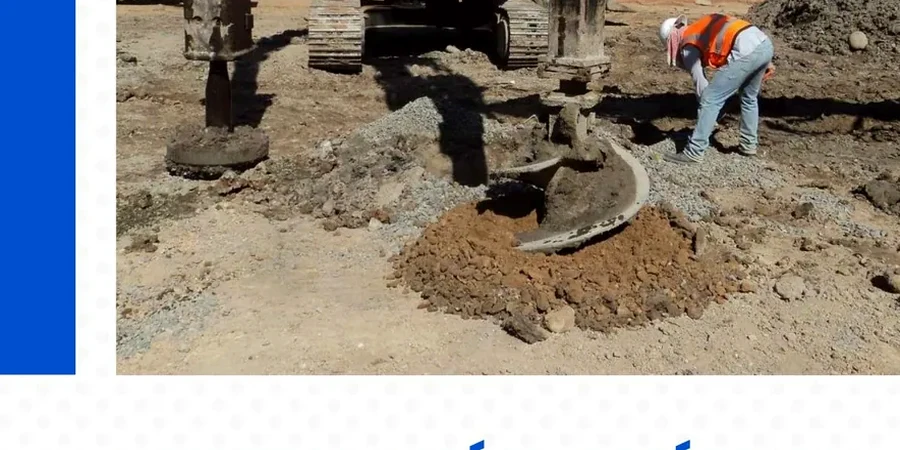
Installation methodWet top-feed or dry bottom-feed vibro-replacement
Design life50 years per NBCC
QC verificationPost-installation CPT and plate load tests

Common questions

What soil conditions in Belleville Ontario are best suited for stone columns?

Soft to firm clays and silts with undrained shear strength between 15 and 50 kPa respond well to stone columns. The technique is not suitable for peat, organic soils, or very sensitive quick clays without careful assessment. Belleville's Leda clay deposits often fall within the treatable range.

How long does settlement take after stone column installation near the Bay of Quinte?

Primary settlement under load typically occurs within weeks because the stone columns provide radial drainage paths. Residual secondary consolidation in the clay continues over months. We specify a loading schedule based on CPT data collected after installation.

What is the cost range for stone column design in Belleville?
Can stone columns replace piles under a Belleville warehouse slab?

Often yes. When the compressible layer is less than 12 meters deep and the structure can tolerate 25 to 50 millimeters of total settlement, stone columns with a load transfer platform frequently eliminate the need for driven or bored piles.

How do you verify the stone column design works?

We require CPT soundings at column centers and midpoints before and after installation. The increase in tip resistance confirms densification. Zone load tests on single columns validate the stiffness modulus used in the settlement model.

Location and service area

We serve projects across Belleville Ontario and surrounding areas.

View larger map