GEOTECHNICAL ENGINEERING
BELLEVILLE ONTARIO
HomeGeophysicsSeismic tomography (refraction/reflection)

Seismic Tomography (Refraction/Reflection) in Belleville Ontario

Knowledgeable. Thorough. Resourceful.

LEARN MORE

We keep seeing the same mistake in Belleville. A firm drills three boreholes, hits shallow limestone, and assumes the bedrock surface is uniform across the entire site. Then excavation starts and the rock profile looks nothing like the boreholes suggested. That assumption costs real money. Seismic tomography gives you the continuous bedrock surface between boreholes. Not a guess. Not an interpolation. An actual measured profile. The city sits on the Paleozoic limestone of the Lake Ontario basin. Rockhead varies fast here. Fresh limestone at three metres can drop to nine metres in twenty metres laterally. Refraction and reflection tomography map that variability before you price the earthworks. We run these surveys across Belleville year-round, including winter work on frozen ground near the Moira River industrial parks.

Seismic tomography replaces the guesswork between boreholes with a measured, continuous profile of the bedrock surface and subsurface layers.
Our service areas

Methodology and scope

We ran a project off Wallbridge-Loyalist Road last season. A commercial warehouse with pad footings. The geotechnical report showed competent limestone at four to five metres. But the site had been a quarry backfill in the 1940s. The boreholes just happened to hit the few remaining bedrock highs. We laid out a 115-metre refraction line with 24 geophones at 5-metre spacing. The tomographic inversion showed a buried channel filled with saturated silty sand, eight metres deep, running diagonally across the building footprint. That channel would have meant differential settlement under the slab. The structural engineer redesigned the footings based on the actual profile. Saved the owner a six-figure change order during construction. We often pair this with MASW surveys to get shear wave velocity profiles for NBCC seismic site classification. The combination works well on Belleville's shallow till over limestone, where both bedrock depth and Vs30 are needed for foundation design.
Seismic Tomography (Refraction/Reflection) in Belleville Ontario
Technical reference — Belleville Ontario

Site-specific factors

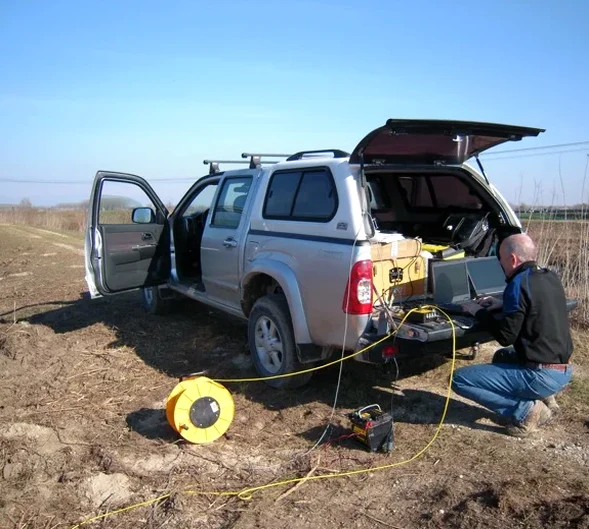
We run a 24-channel Geometrics Geode system with 4.5 Hz geophones for most Belleville jobs. The equipment is compact enough to deploy on tight urban lots in the Old East Hill neighbourhood. Refraction surveys need a straight line with clear access. That gets tricky in built-up areas. We sometimes use reflection profiling there instead. Reflection works on shorter spreads and can image deeper. But it needs a stronger source. In Belleville, the biggest field challenge is winter frost. Frozen ground in January and February raises the near-surface velocity. It creates a high-velocity layer that can mask the true bedrock. We correct for that in processing. Another local issue is cultural noise. Traffic on Highway 401, rail activity near the CN corridor, and quarry blasting east of town all generate vibrations. We stack multiple shots at each source point to suppress that noise. The result is a clean tomogram. Skip this step and the inversion model picks up phantom layers that don't exist in the ground.

Need a geotechnical assessment?

Reply within 24h.

Email: contact@geotechnical-engineering.org

Relevant standards

ASTM D5777-18 Standard Guide for Using the Seismic Refraction Method for Subsurface Investigation, NBCC 2020 Division B Part 4 Seismic Provisions, CSA A23.3 Design of Concrete Structures (foundation design inputs), ASTM D7400-17 Standard Test Methods for Downhole Seismic Testing

Technical data

ParameterTypical value
MethodSeismic refraction and reflection tomography
Depth of investigation (refraction)Typically 15-35 m with standard spreads; up to 60 m with longer lines
Depth of investigation (reflection)25-150 m depending on source energy and geophone spacing
Geophone spacing2 to 10 m depending on target resolution
Source typeSledgehammer (shallow), accelerated weight drop, or explosives (deep/reflection)
Data processingTomographic inversion (refraction); CMP stacking and migration (reflection)
Applicable standardsASTM D5777, NBCC 2020 seismic provisions, CSA A23.3
Typical deliverablesP-wave velocity tomograms, interpreted geologic cross-sections, bedrock surface maps

Common questions

How much does a seismic tomography survey cost in Belleville?
How deep can seismic refraction see in the Belleville limestone?

With a 115-metre spread and a sledgehammer source, we typically image 20 to 25 metres into competent limestone. Using an accelerated weight drop extends that to about 35 metres. For deeper targets, we switch to reflection profiling, which can map structure down to 100 metres or more.

Can you run a seismic survey on a small residential lot near downtown Belleville?

Yes. We use short spreads and reflection methods where space is tight. A 46-metre line with 2-metre geophone spacing fits most urban lots. The equipment is low-impact. No drilling. No heavy vehicles. We complete most residential surveys in under three hours.

Location and service area

We serve projects across Belleville Ontario and surrounding areas. More info.

View larger map